


Renting a car in Chile to explore Patagonia: best rental companies, car prices, and how to cross the Argentinian border
For us, traveling through Patagonia was one of the most epic road trips we’ve ever had. We saw beautiful landscapes along the way, and spotted tons of amazing animals like vicuñas, condors, and flamingoes. The freedom that comes with having your own set of wheels is incredible, but the logistics of renting a car and crossing the border between Chile and Argentina require a little more than just booking a rental. If you’re used to the open borders from the Schengen zone like we are, you’ll appreciate this guide on how to rent a car in Chile. We’ll talk about the best rental companies, preferred routes and pick-up locations, as well as all the logistics that come with crossing the border with Argentina.
Why rent a car in Patagonia?
We knew from the start that Patagonia was made for road trips. The sheer size of this region (over 1 million square kilometers) means public transportation options can be limited and not always reliable. And if you’re planning to venture into less-visited areas, you’ll definitely be out of luck. Having a car gave us the flexibility to explore the secluded corners of both Chilean and Argentine Patagonia. On top of that, we were able to streamline our limited time in the region because we had a car. No waiting around for buses to arrive, straight to the car we went! From quiet lakesides to hidden hiking trails, renting a car lets you access all the best spots without sticking to a schedule. Plus, the drive itself is part of the experience!
Now, we keep mentioning Patagonia instead of just saying Chile, and that is because we highly recommend you get your rental in Chile, and not Argentina. For us, renting a car in Patagonia is equal to renting one in Chile. 😉 There are a few reasons for this, but it mainly comes down to the fact that Chile has higher availability of car rentals, which results in lower costs. So, from this point on we assume you make the right choice of renting your car in Chile for your upcoming Patagonia trip.
Looking for Patagonia inspiration? Check out our guide to Perito Moreno Glacier, one of the world’s most impressive glaciers. And if you’re after the best hike in Patagonia, don’t miss our guide to the iconic Mount Fitz Roy hike.
What to know before renting a car in Chile
Renting a car in Chile is fairly straightforward, but there are a few things you should know to avoid surprises. We’ll go over all the necessary things to make your Patagonia adventure as smooth sailing as possible!
Car rental companies
You’ll find both international and local rental companies in all of Chile. Our experience during our trip to Patagonia was with Salfa Rent, a Chilean rental company. The main reason for going with them was to support local businesses, as well as a guarantee that we could cross the border with Argentina (more on that later). If you’re uncomfortable dealing with local businesses (we had to communicate in broken Spanish), do know that international chains like Hertz, Europcar, and Avis are also readily available. These companies have offices in major cities like Santiago, Puerto Natales, and Punta Arenas, and especially Europcar seems to be the recommended “big player” to go with. Explore rental car options in Chile.
The rental car itself
Most rentals in Chile come with manual transmission. If you’re not used to driving a stick you should make sure you request an automatic. Since Kelvin has no issues driving manual we went with that one in order to save some money (automatic transmission is a bit pricier). A 4×4 vehicle is recommended in Patagonia, but you definitely don’t have to have one. We rented a Chevrolet Onix and did just fine! For the more rugged parts of Patagonia a 4×4 would’ve come in handy, sure, but you’ll do fine without one.
We paid around CLP 244,000 for our six-day rental, which comes down to CLP 40,666 a day.
Insurance
Chile is very strict about car insurance, so we recommend purchasing insurance for the rental car. Our rental agreement included CDW and other coverage, but we read from many people online who faced issues when returning the car without insurance. Sometimes the rental company forces you to buy insurance on the spot as well. Check if your credit card or insurance from back home covers your rental. If it doesn’t, we highly recommend buying the extra insurance to avoid issues when returning the car. Expect to pay anywhere from CLP 15,000 to CLP 30,000 per day for the insurance. You can get travel insurance with SafetyWing to stay covered throughout your trip.
Fuel costs
Fuel is expensive in Chile, with prices for gas being around CLP 1,400 per liter, sometimes even more. Of course, this guide wouldn’t be an actual guide if we didn’t have an insider tip for you: fill up your tank in Argentina! Argentinian gas prices were over 40% cheaper than Chilean prices during our October 2024 trip. We filled up our tank at YPF (Argentina) and paid around ARS 850 per liter. Going by the official rate that amounts to EUR 0.8, but we paid by credit card and paid (close to) the blue rate – around EUR 0.74/liter. Also, make sure to fill up whenever you see a gas station as they can be few and far between on long stretches of road. We recommend filling up small amounts in Chile only when you have to, and filling the tank completely in Argentina.
Road conditions
The main roads in Chile are well-maintained, we absolutely never had any issues with them. We even joked that the roads in Chile were much, much better than the ones back home! That all changed the moment we arrived in Argentina, though. The first 100 kilometers of the Argentinian side of Patagonia were especially rough. We encountered gravel roads, potholes, and even flooded sections. So while we said we didn’t need a 4×4 to wander off the beaten track, we do realize that an SUV would’ve been much more convenient to battle all the potholes in the road! No wonder we learned the Spanish word for potholes (“baches”) so quickly. 😉
Driver’s license
We found Chile pretty chill when it comes to renting cars to foreigners. According to the law, we had to have (1) a valid Belgian driver’s license, and (2) an International Driver’s License in order to drive legally in Chile. However, when we picked up the car they didn’t ask for the International one (even though we had one). We also weren’t stopped by police so don’t know if they would’ve asked us to show it either. The road signs are in Spanish, but many are intuitive (speed limits, stop signs, etc.).

Crossing the border into Argentina
Once we were ready to make the journey across the border into Argentina, we were excited about the next leg of our road trip. But as with any border crossing, it’s important to prepare in advance. Here’s what we learned.
Border crossing document
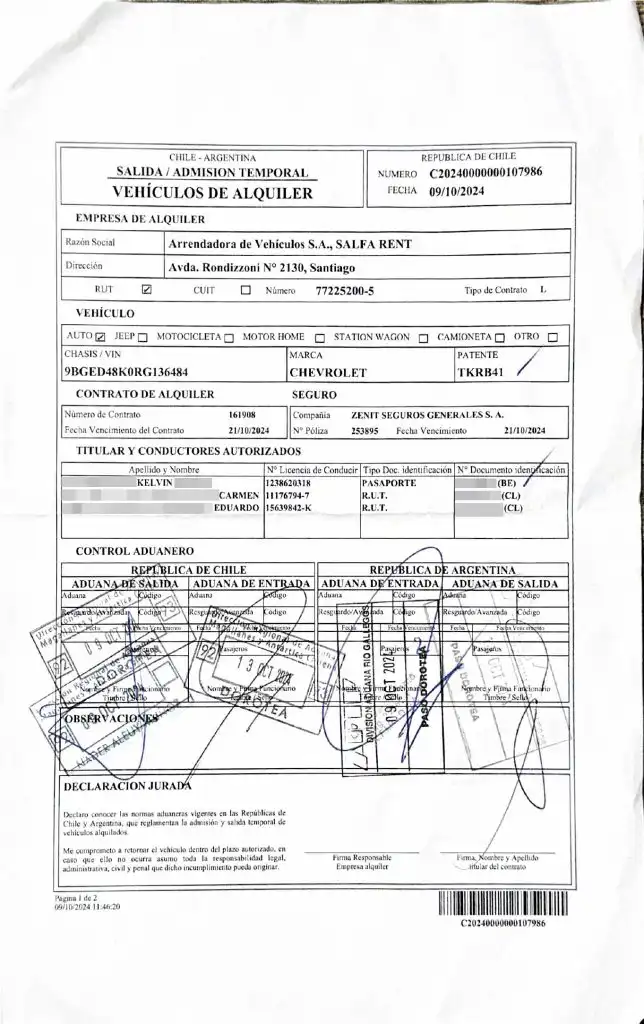
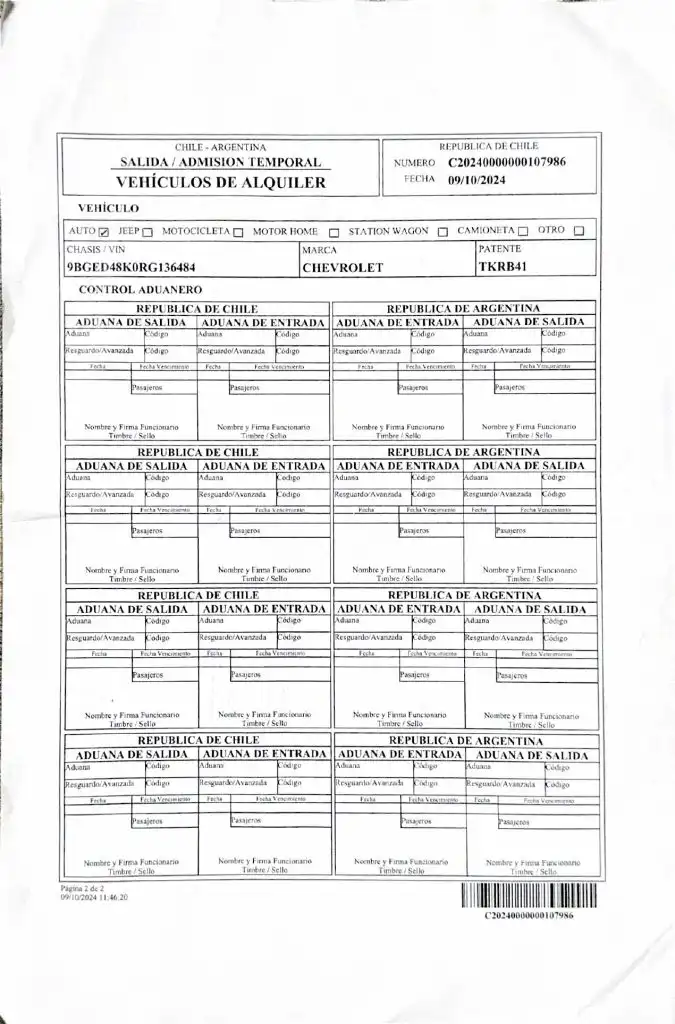
Not all car rental companies allow people (or foreigners) to cross the border. Since this was a must for us, we did extensive research on what companies do, and which ones don’t allow you to cross the border. There’s some logistics to it:
Your rental company needs to issue a special document (essentially a “passport” for the vehicle) giving you permission to take the car into another country. This comes with an extra fee and typically allows for 5–6 border crossings during your rental period. It’s super important to confirm during the booking process that your rental agency is okay with cross-border travel and knows your plans. So before you make any reservation, reach out to the car rental company to ask if they allow crossing the border.
At the border, every traveler needs to go through migration with their passport (double-check if anyone in your group needs a visa). The driver will also need to handle the car paperwork, including the rental agreement and the extra cross-border document, at the aduana (customs) line. The process itself is quick, it only took about 10 minutes for us (waiting in line not included).
Good to know
The extra border-crossing document cost us CLP 119,000 on top of the CLP 244,000 for the car. With Salfa Rent, crossing the border costs CLP 238,000 for 1 to 4 days, CLP 119,000 for 5 to 15 days, and CLP 154,700 for 16 to 30 days.
We do have a bit of a “story time” regarding this document. As we mentioned again and again, we did a lot of research on how to go on this multi-country roadtrip. You can imagine our surprise when we arrived at the border and weren’t allowed to cross! The rental company forgot to give us the document that acts as “passport of the car”, even though we paid for it. After multiple calls back and forth with Salfa Rent, and with the help of a really friendly border patrol officer, we finally managed to leave Chile. That’s why we’ve included pictures of our border crossing document below. If you’re planning on crossing the border and you don’t have this document with you when you pick up the car, make sure to ask for it!
Border crossing locations

There are several border crossings between Chile and Argentina, but the most important and popular ones to explore Patagonia are in the south. Here’s an overview of the key crossings to help you plan your journey:
1. Paso Cardenal Samoré
Opening hours: 8:00 AM to 7:00 PM, according to the official government website.
This is the main crossing in Patagonia’s lake district, linking Osorno (Chile) with Villa La Angostura and Bariloche (Argentina). With mostly paved, well-maintained roads, it’s a smooth drive through spectacular scenery. The facilities are efficient, though it can get busy during peak travel times because of its beauty. This route is ideal if you’re looking to add some magnificent landscapes to your journey. You can get your rental car in advance by starting from Valdivia, or reach out to local companies in Entre Lagos or Osorno. Explore rental car options from Valdivia.
2. Paso Huemules
Opening hours: 8 AM to 8 PM on Argentinian side, 9 AM to 9 PM Chilean side. Taken from the official government website.
Close to Coyhaique (Chile) and Esquel (Argentina), this quieter border crossing is popular with travelers on the Carretera Austral. The roads are in decent shape, though expect some gravel sections. Traffic varies but is generally moderate depending on the season. The closest city from where you can get your rental car in advance is Coyhaique, less than an hour away. Explore rental car options from Coyhaique.
3. Paso Jeinimeni
Opening hours: 8 AM to 8 PM (entry), 8 AM to 7:30 PM (exit). Taken from the official government website.
This crossing links Chile Chico (Chile) and Los Antiguos (Argentina). It’s perfect for travelers exploring the stunning Carretera Austral or people heading into the Argentine side of Patagonia. The route is scenic, though mostly gravel, and basic facilities are available. Trucks don’t use this crossing, which means you won’t have to queue for long until it’s “your turn”. That being said, they are a bit more thorough here in searching your baggage and vehicle, from what we’ve heard. The closest city from where you can get your rental car in advance is Coyhaique, 3 hours away. You can also try your luck on the spot in Chile Chico with a local rental company. Explore rental car options from Coyhaique.
4. Paso Río Don Guillermo (Cerro Castillo)
Opening hours: 8 AM to 7:30 PM every day. Taken from the official government website.
This is the go-to border crossing for anyone visiting Torres del Paine in Chile and the Perito Moreno Glacier in Argentina. Conveniently located near El Calafate, the roads are a mix of paved and gravel but generally in great shape. The customs and migration offices are well-organized to handle the steady flow of tourists, though peak season can bring delays. Buses and trucks also frequent this crossing, depending on whether you arrive before or after them you might have to wait a bit. The nearest “hub” from where you can get your car is Puerto Natales. Explore rental car options from Puerto Natales.
5. Paso Dorotea
Opening hours: 8 AM to 9:30 PM every day. Taken from the official government website.
If you’re traveling between Puerto Natales (Chile) and Río Turbio (Argentina) and prefer a quieter route, Paso Dorotea is a great option. The roads here are pretty well maintained and take you straight through some mountains, which adds a bit of adventure. Traffic is light, so crossing is usually quick. It’s the crossing we took on our way to El Chaltén and El Calafate, and we highly recommend it! The place is small, which means you can be in and out of there in under 10 minutes. What was also nice is that the first time we crossed here, neither our car nor our bags were searched. The nearest “hub” from where you can get your car is Puerto Natales. We got ours from Punta Arenas, which is just a 3 hour drive from the south. Explore rental car options from Puerto Natales or rental car options from Punta Arenas.
6. Paso Austral (Integración Austral)
Opening hours: day-round (summer), 8 AM to 10 PM in winter. Check the official government website for up to date information about opening times.
For those heading to Tierra del Fuego or Puerto Natales, Paso Austral is a key crossing connecting Punta Arenas (Chile) with Río Gallegos (Argentina). The roads here are paved and well-maintained, but it’s a busy hub for both tourists and commercial traffic. You should plan for potential wait times, especially during high season (Dec – Feb). The closest “major hub” from where you can get a car is Punta Arenas, which is about 2 hours away. Explore rental car options from Punta Arenas.
7. Paso Los Libertadores
Opening hours: day-round (summer), 8 AM to 8 PM in winter according to this website. This border crossing might close because of bad weather (like heavy rain or snowfall).
The Paso Los Libertadores is the most frequently used border crossing near Santiago. It connects Chile’s capital with Mendoza in Argentina. It’s a well-maintained and scenic route through the Andes, with paved roads and modern facilities at the border. While it’s a convenient crossing for trips in central Chile and Argentina, it’s not a practical starting point for exploring Patagonia. For instance, driving from Santiago to Perito Moreno takes well over (!) 30 hours. For Patagonia adventures, flying from Santiago to Punta Arenas or from Santiago to Puerto Natales is a far better option. It will save you time, hassle, and above all: money. Still looking to depart from Santiago? Book your rental car in advance here.
What to bring when crossing the border
At the border, you’ll need the following:
- Your passport.
- Your PDI border document (looks like a receipt) that you got when entering Chile. You’ll only need it to leave Chile – you’ll get a new one when you re-enter the country. And whatever you do when you enter Chile, don’t lose it!
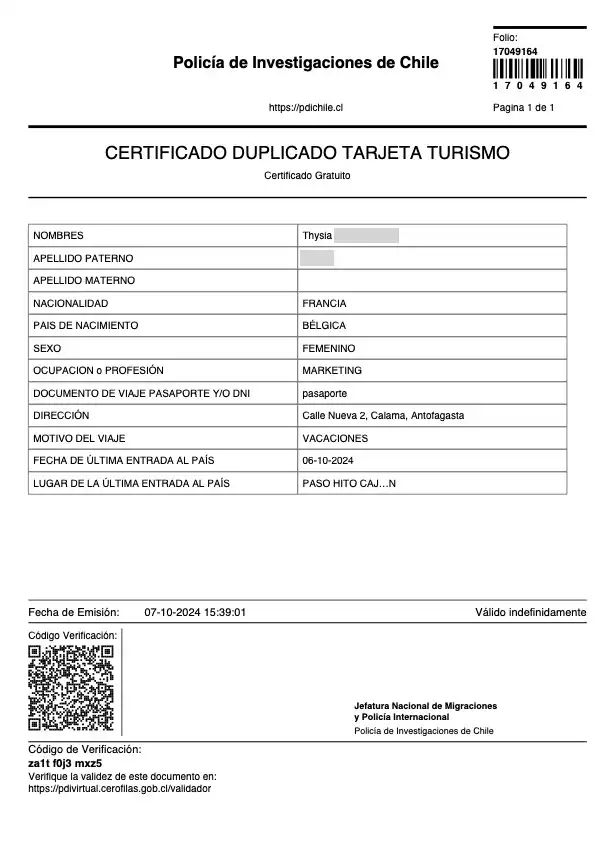
- The car rental agreement.
- Proof of insurance (from the rental company) for both Chile and Argentina, usually included in the car rental agreement papers.
- The car’s paperwork, usually in some sort of folder.
- The border crossing permit.
In total, we had to show five different car documents to the border control officer.
The process of crossing the border
Crossing from Chile into Argentina is a two-step process, involving both Chilean and Argentine immigration and customs checks. We’ll discuss the steps to leave Chile and enter Argentina, if you’re looking for the other way around you can just do the following in reverse. 😉
First, you’ll stop at the Chilean side, where they’ll stamp your passport and take a look at the car documents. You’ll have to visit two counters here, one for immigration and the other one for customs. Then, you’ll drive to the Argentine side for another set of paperwork and passport control, again with a visit to two counters. Both sides require you to declare any goods you’re bringing across, including meat products, seeds, fruits, and even honey.
Insider tips for renting a car in Chile, crossing the border, and driving in Patagonia
- Rent in advance: Rental cars can be in high demand, especially during peak seasons. Book early to ensure availability and get better rates.
- Border crossing permissions: To cross between Chile and Argentina, inform the rental company when (or even better: before) you book. Make sure to ask for a “permiso de circulación” (border-crossing permit). Know that this involves an additional fee.
- Inspection tips when picking up the car: Document any scratches or damage with photos and video. Check the tires (including the spare), and ensure lights, wipers, and all essentials work. Confirm the fuel level matches the agreement, and make sure to take pictures of the inside as well!
- Inspection tips when crossing the border: Rental cars are thoroughly inspected at the border. Clean out any food or trash to avoid delays, and don’t carry fresh produce, as it’s most likely prohibited.
- Insurance matters: Double-check that the car is insured for both countries. Some rental companies offer supplemental insurance for cross-border travel.
- Fuel up before crossing: Gas stations can be few and far between in Patagonia. Top up your tank (in Argentina) to avoid any stress.
- Be patient: Border crossings can take some time, especially during peak travel periods. Pack snacks, water, and a good dose of patience for the process.
- Traffic signs matter: Pay attention to speed limits, wind warnings, and road conditions. Patagonia’s known for its unpredictable weather!

Kelvin
Kelvin is the tech mind behind Tasting Sunsets. He takes care of everything from managing the website to finding the best travel deals and capturing drone footage of our trips. His favorite way to explore is going on a road trip. So far, Australia has been his favorite destination for its mix of nature and cities. With a background in IT, he also ensures the blog runs smoothly and securely.


Comments
-
-
-

Mark Pysklo
May 14, 2025
Hi Kevin,
Thanks for all of informations.
One major question, were you able to communicate with Salfa rent in english ?
I cant find any link to english version of their web site.
And comparing prices they offer best ones for know.I will appreciate your answer.
-

Tasting Sunsets
May 14, 2025
Hi Mark!
Thank you for your comment. I was able to communicate with Salfa Rent with a mixture of English and “Google Translate Spanish”. We first made the reservation via their website (in Spanish, but your browser can probably translate most of it), and then we sent a follow up email in Spanish and English. I’ve dug up the email we sent them to ask for the border crossing document for you:
“Estimado equipo de Salfa Rent,
Espero que este correo les encuentre bien. Recientemente, reservé un coche de alquiler con su compañía y mi número de confirmación es Nº 194875. Aunque planeo explorar Chile, también tengo la intención de viajar a Argentina y me gustaría solicitar los documentos necesarios para cruzar la frontera.
¿Podrían por favor proporcionarme información sobre el costo de este permiso, el proceso de pago y los pasos necesarios para gestionarlo? Además, agradecería si pudieran confirmar cuándo estarán listos los documentos.
Cabe mencionar que he usado una traducción para este mensaje, ya que no hablo español, ¡pero espero haberme explicado bien!
Gracias por su ayuda.
Kelvin Vermeulen[ENGLISH]
Dear Salfa Rent Team,
I hope this email finds you well. I have recently booked a car rental with your company, and my confirmation number is Nº 194875. While I plan to explore Chile, I am also planning a trip to Argentina and would like to request the necessary documents to cross the border.
Could you please provide me with information on the cost of this permit, the payment process, and the steps required to arrange it? Additionally, I would appreciate it if you could confirm when the documents will be ready.
Thank you for your assistance.”
After this email, we sometimes got a response in Spanish and sometimes in English, which worked well enough. We also had to call their support once, and the guy on the phone was really fluent in English so all good there too!
We can really recommend Salfa Rent, hope our comment helped you out a bit ☺️ Have fun in South America!
Kelvin
-
Ziggy
December 31, 2024
Thanks. This is very helpful.